About TrestleBoard
TrestleBoard was built for the trestle board committee of Indian Land Masonic Lodge No. 414, to produce a four-to-six page newsletter every month and the PDF that goes out with it.
What it costs
Nothing, for anybody not making money with it. A lodge, a church, a charity, a school, a public body or a person at home may use it, copy it, change it and pass it on, at no cost and without asking. That is the PolyForm Noncommercial Licence 1.0.0, and its full text is compiled into the program so it travels with every installed copy — Help → Licence.
Making money with it — selling it, selling a service built on it, or using it in the running of a for-profit business — needs a separate licence. Ask for one by opening an issue.
The typefaces are somebody else's work
Twenty families ship inside the program, used under the SIL Open Font License 1.1, with their designers, sources and pinned versions recorded in docs/FONTS.md. Their complete licence text ships inside the installer too and is reachable from Help → Fonts and licences — the OFL requires that of anything redistributing the fonts, and shipping them without it would not be enough.
Nothing here grants any right in the names, arms or symbols of Indian Land Masonic Lodge No. 414 or of any Grand Lodge.
How it is built
- Windows, macOS and Linux, on .NET 10 and Avalonia.
- Its own layout and drawing engine, on SkiaSharp and HarfBuzzSharp. The same code draws the editor and the PDF, which is what makes what you see what prints.
-
Newsletters are
.tboardfiles — a container holding the document and the untouched original of every photograph in it. - Fonts are bundled only. No font installed on your computer is ever used. Every face is a static instance recorded with its SHA-256, which is what lets one newsletter paginate identically on all three operating systems.
- Nothing leaves your machine. No account, no server, no telemetry. The only outbound request the program makes is asking the releases page whether a newer version exists.
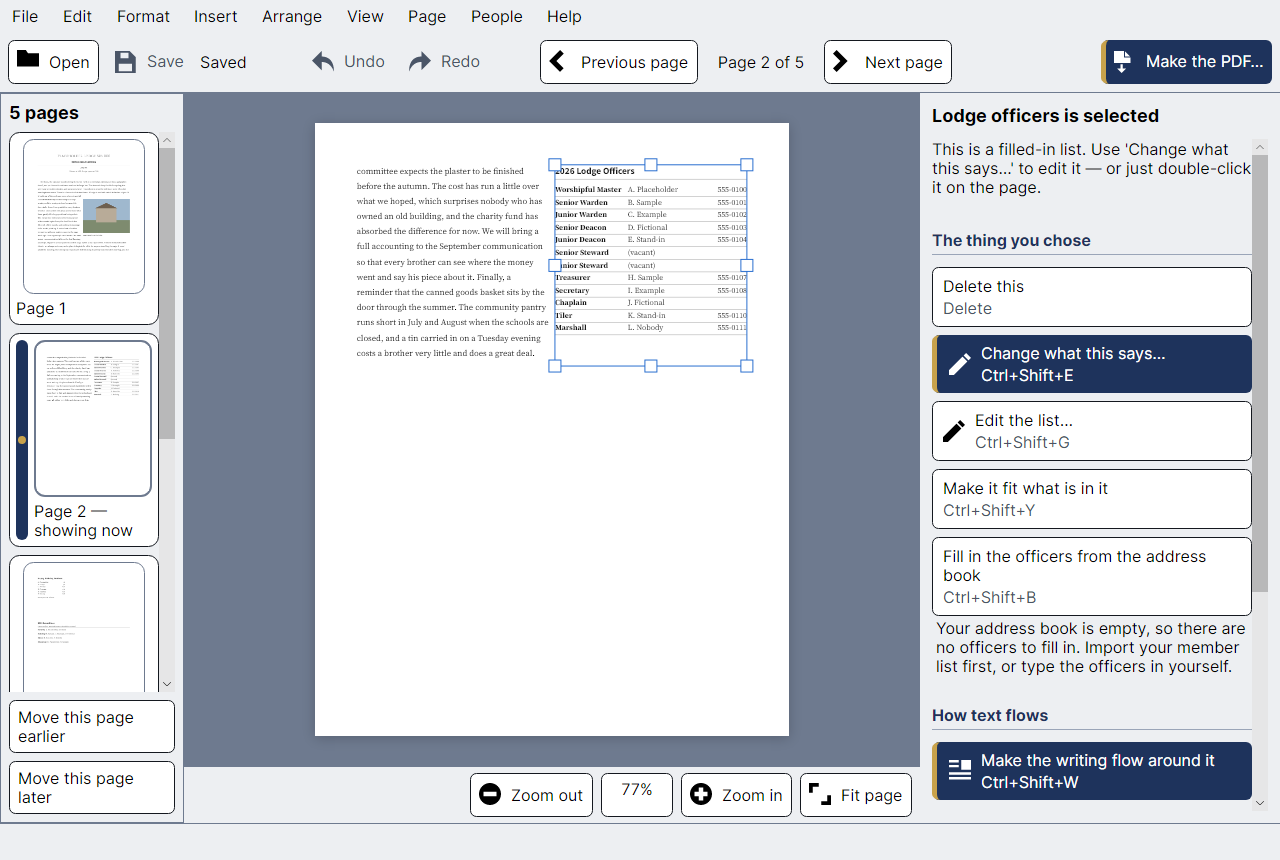
About the pictures on this site
They are generated, not photographed: a harness opens the real program against fictional records and a temporary settings folder, and writes the images out. It cannot read a real address book, because it never looks in the place one would be. That is a rule of the project rather than a habit — the example PDFs this program was designed from hold real members' names and telephone numbers, and none of that has ever been in this repository.
The source
Everything is on GitHub: the program, the plan it was built to, a specification for each of its milestones, and this site. Faults and requests go in the issues.
If you are a secretary at another lodge wondering whether this would suit you: install it, open Help → Show me an example newsletter, and take it apart. That is what the example is for.